
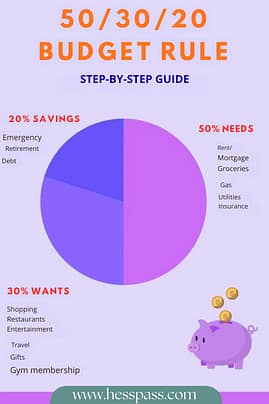
The 50-30-20 rule is a simple way to budget your money, especially for those who are new to budgeting or dislike the idea of tracking every individual expense. Here’s how it works: 50% of your monthly take-home income goes towards your needs, 30% goes towards your wants, and the remaining 20% goes towards your savings.
It only requires you to track and divide your monthly expenses into three main spending categories: Needs, Wants, and Savings.
If the thought of budgeting sounds intimidating, you may want to consider giving the 50-30-20 budget rule a try. This budgeting strategy is perfect for beginners who want to take control of their finances without getting overwhelmed by complex spreadsheets or apps.
What is the 50/30/20 Budget Rule?
The 50/30/20 budget rule is a straightforward budgeting framework created by Senator Elizabeth Warren in her book “All Your Worth: The Ultimate Lifetime Money Plan.” It divides your after-tax income into three simple categories, making it easy to allocate your money wisely without micromanaging every dollar.
This method has gained popularity because it strikes a balance between financial responsibility and enjoying life. You’re not restricting yourself to bare necessities, nor are you spending recklessly—instead, you’re finding a middle ground that works for most people.
What Are the Three Categories Included in the 50-30-20 Budget?
The three categories are designed to cover all aspects of your financial life:
1. Needs (50%): Essential expenses you must pay to survive and maintain your basic lifestyle. These are non-negotiable items like housing, utilities, groceries, transportation, insurance, and minimum debt payments.
2. Wants (30%): Discretionary spending on things that enhance your quality of life but aren’t essential for survival. This includes dining out, entertainment, hobbies, streaming subscriptions, vacations, and shopping for non-essential items.
3. Savings and Debt Repayment (20%): Money set aside for your future, including emergency funds, retirement contributions, investments, and extra payments toward debt beyond the minimum.
How Do You Calculate Percent of Budget?
Calculating your budget percentages is straightforward once you know your after-tax income. Here’s the formula:
Budget Category Amount = After-Tax Income × Percentage
For example, if your monthly after-tax income is $4,000:
- Needs: $4,000 × 0.50 = $2,000
- Wants: $4,000 × 0.30 = $1,200
- Savings: $4,000 × 0.20 = $800
To check if your current spending aligns with the 50/30/20 rule, add up all expenses in each category and divide by your total income, then multiply by 100 to get the percentage.
How Much of Your Income Should Go to Bills?
According to the 50-30-20 rule, your essential bills (needs) should consume no more than 50% of your after-tax income. This includes:
- Rent or mortgage payments
- Utilities (electricity, water, gas, internet)
- Groceries
- Transportation (car payment, gas, public transit)
- Insurance (health, auto, home/renters)
- Minimum debt payments
If your bills exceed 50% of your income, you may need to find ways to reduce costs, such as downsizing your living space, refinancing debt, or finding more affordable insurance options.
How to Budget with the 50-30-20 Rule
Ready to implement this budgeting method? Follow these five simple steps to get started.
Step 1: Calculate Your After-Tax Income
Your after-tax income is the money you actually take home after taxes, retirement contributions, and other deductions are removed from your paycheck. This is the foundation of your budget.
For employees with regular paychecks:
- Look at your pay stub and find your net pay (take-home pay)
- Multiply your per-paycheck amount by the number of paychecks you receive per month
- If you’re paid biweekly (every two weeks), multiply by 2.17 to get your average monthly income
For self-employed individuals:
- Calculate your total monthly income
- Subtract estimated taxes (typically 25-30% for self-employment tax and income tax)
- Subtract any business expenses
- What remains is your after-tax income
Example: Sarah earns $60,000 per year. After taxes and deductions, her monthly take-home pay is $3,750. This is the number she’ll use for her 50-30-20 budget.
Step 2: Limit Your Needs to 50% of Your Income
Now that you know your after-tax income, calculate 50% of that amount. This is your limit for essential expenses.
Using Sarah’s example:
- After-tax income: $3,750
- 50% for needs: $1,875
List all your essential expenses:
- Rent: $1,100
- Utilities: $150
- Groceries: $300
- Car payment & insurance: $250
- Health insurance: $75
- Total: $1,875 ✓
Sarah’s needs fall exactly at 50%, which is perfect. If your needs exceed 50%, look for areas to cut back:
- Consider getting a roommate to split housing costs
- Shop at discount grocery stores or buy generic brands
- Bundle insurance policies for discounts
- Refinance high-interest debt
- Use public transportation instead of owning a car
Step 3: Limit Your Wants to 30% of Your Income
Wants are where you get to enjoy life. Calculate 30% of your after-tax income for this category.
Sarah’s wants budget:
- After-tax income: $3,750
- 30% for wants: $1,125
Examples of wants include:
- Dining out and takeout
- Entertainment (movies, concerts, events)
- Streaming services (Netflix, Spotify, etc.)
- Gym membership
- Hobbies and recreation
- Shopping for clothes, electronics, or home décor
- Vacations and travel
- Premium phone plans or upgrades
Pro tip: The line between needs and wants can sometimes blur. A basic cell phone plan is a need in today’s world, but upgrading to the latest iPhone every year is a want. Groceries are a need, but ordering DoorDash three times a week is a want.
Track your discretionary spending for a month to see where your money really goes. You might be surprised at how quickly small purchases add up!
Step 4: Spend 20% of Your Income on Savings and Debt Payments
The final 20% is arguably the most important for your long-term financial health. This is money that builds your future security and freedom.
Sarah’s savings and debt repayment:
- After-tax income: $3,750
- 20% for savings/debt: $750
This category should include:
Building savings:
- Emergency fund (aim for 3-6 months of expenses)
- Retirement accounts (401(k), IRA, Roth IRA)
- Investment accounts
- Savings for specific goals (down payment, education, etc.)
Paying down debt:
- Extra payments on credit cards beyond the minimum
- Additional principal payments on student loans
- Extra mortgage payments to build equity faster
Important: Minimum debt payments go in the “Needs” category (50%). Only extra payments beyond the minimum go in this 20% category.
Sarah’s allocation:
- Emergency fund: $300
- Roth IRA: $300
- Extra credit card payment: $150
- Total: $750 ✓
If you have high-interest debt, consider prioritizing debt repayment before building substantial savings beyond a small emergency fund ($1,000-$2,000). Once the debt is paid off, redirect that money toward savings and investments.
Step 5: Make Adjustments and Stick to It!
The 50-30-20 rule is a guideline, not a rigid law. Your first month won’t be perfect, and that’s okay. The key is to track your spending, identify where you’re going over or under in each category, and make adjustments.
Tips for sticking with your budget:
Automate everything: Set up automatic transfers to savings accounts and automatic bill payments. This removes the temptation to spend money that should go toward needs or savings.
Review monthly: Spend 30 minutes at the end of each month reviewing your spending. Did you stay within the guidelines? Where did you struggle? What can you improve?
Use budgeting tools: Apps like Mint, YNAB (You Need a Budget), or even a simple spreadsheet can help you track spending across categories.
Be flexible: Life happens. Some months you might need to spend more on needs (like car repairs). That’s fine—just adjust your wants or temporarily reduce savings to compensate, then get back on track next month.
Celebrate wins: Did you stick to your budget for three months straight? Treat yourself to something from your “wants” category. Progress deserves recognition!
50/30/20 Budget Example
Let’s look at a complete example to see how this works in real life.
Meet James:
- Monthly after-tax income: $5,000
- Single, rents an apartment, has student loans
James’s 50-30-20 Budget Breakdown:
NEEDS (50% = $2,500):
- Rent: $1,400
- Utilities (electric, water, internet): $200
- Groceries: $400
- Car insurance & gas: $250
- Health insurance: $100
- Cell phone: $50
- Student loan minimum payment: $100
- Total: $2,500
WANTS (30% = $1,500):
- Dining out & coffee: $400
- Entertainment (movies, concerts): $200
- Gym membership: $60
- Streaming services: $40
- Shopping (clothes, gadgets): $300
- Weekend trips & activities: $400
- Miscellaneous: $100
- Total: $1,500
SAVINGS & DEBT REPAYMENT (20% = $1,000):
- Emergency fund: $400
- 401(k) contribution: $400
- Extra student loan payment: $200
- Total: $1,000
James follows this budget consistently and finds that he’s able to enjoy life while also building a strong financial foundation. Within six months, he has $2,400 in his emergency fund and has made significant progress on his student loans.
Is the 50/30/20 Budget Rule Good?
Like any budgeting method, the 50-30-20 rule has both advantages and drawbacks. Whether it’s right for you depends on your financial situation, goals, and personality.
Pros of the 50/30/20 Budget
1. Simplicity: You only need to track three categories instead of dozens. This makes budgeting less overwhelming and more sustainable for beginners.
2. Flexibility: Unlike zero-based budgeting, you don’t need to account for every single dollar. As long as you stay within the broad categories, you have freedom in how you spend.
3. Balanced approach: The rule ensures you’re covering essentials, enjoying life, and building financial security simultaneously. You’re not depriving yourself, but you’re also not living paycheck to paycheck.
4. Easy to remember: The round numbers (50-30-20) are simple to recall and calculate, even without a calculator or app.
5. Encourages savings: By automatically allocating 20% to savings, you’re building wealth consistently rather than saving “whatever’s left over” (which is often nothing).
6. Scalable: This method works whether you earn $2,000 or $20,000 per month. The percentages adjust to your income level.
7. Promotes financial awareness: Even though it’s simple, the 50-30-20 rule requires you to think about your spending patterns and make conscious decisions about your money.
Cons of the 50/30/20 Budget
1. May not fit all income levels: If you live in an expensive city or have a low income, 50% might not be enough to cover basic needs. Conversely, high earners might find that 50% is far more than they need for essentials.
2. Oversimplifies complex situations: The three-category system might be too broad for people with specific financial goals, multiple debt streams, or complex financial situations.
3. “Wants” category can enable overspending: Knowing you have 30% allocated to wants might encourage unnecessary spending rather than finding less expensive alternatives.
4. Doesn’t account for irregular expenses: Annual or semi-annual expenses (car registration, insurance premiums, holiday gifts) can throw off your monthly budget if you haven’t planned for them.
5. Requires discipline: Just because you can spend 30% on wants doesn’t mean you should if you have aggressive financial goals. Some people might need stricter guidelines.
6. May not prioritize debt aggressively enough: If you have significant high-interest debt, 20% might not be enough to make meaningful progress. You might need a more aggressive debt payoff strategy.
7. Subjective categorization: The line between “needs” and “wants” isn’t always clear, which can lead to self-justification and budget creep.
Bottom line: The 50-30-20 rule is an excellent starting point for budgeting, especially if you’re new to managing money. As you become more financially savvy, you might adjust the percentages or graduate to a more detailed budgeting method.
Other Popular Budgeting Methods to Consider
If the 50-30-20 rule doesn’t quite fit your needs, consider these alternative approaches:
Zero-Based Budget
With zero-based budgeting, every dollar of income is assigned a specific purpose, so your income minus expenses equals zero. This method gives you complete control and awareness of where every dollar goes.
Best for: Detail-oriented people who want maximum control over their finances and those with variable income who need to be very intentional about spending.
Example: If you earn $4,000 per month, you allocate every single dollar to categories (rent, food, savings, etc.) until you have $0 unallocated.
Envelope Budget System
This cash-based system involves putting cash into physical (or digital) envelopes for different spending categories. Once an envelope is empty, you can’t spend any more in that category until the next month.
Best for: People who overspend on credit/debit cards and need the psychological impact of spending physical cash.
Example: You might have envelopes for groceries ($400), dining out ($200), entertainment ($150), and gas ($100).
Budget Calendar Method
This approach involves mapping out your income and expenses on a calendar, ensuring you have enough money to cover bills on their due dates. It’s particularly useful for managing cash flow.
Best for: People living paycheck to paycheck, those with irregular income, or anyone who struggles with timing expenses.
Example: Mark when each paycheck arrives and when each bill is due, then allocate specific paychecks to specific bills.
70/20/10 Rule Money
This simplified budget allocates 70% to living expenses (both needs and wants combined), 20% to savings and investments, and 10% to debt repayment or charitable giving.
Best for: People who want even more simplicity than 50-30-20 and don’t need to distinguish between needs and wants.
Example: On $5,000/month income, you’d have $3,500 for all living expenses, $1,000 for savings, and $500 for debt/giving.
60/30/10 Rule Budget
This variation allocates 60% to committed expenses (fixed bills and essentials), 30% to savings and debt repayment, and 10% to fun money or discretionary spending.
Best for: Aggressive savers who want to prioritize financial goals over lifestyle spending, or those recovering from debt.
Example: With $4,000 income, you’d have $2,400 for essential bills, $1,200 for savings/debt, and only $400 for wants.
30-30-30-10 Budget
This method divides your income into four equal-ish portions: 30% for housing, 30% for other living expenses, 30% for financial goals (savings and debt), and 10% for fun.
Best for: People who want to ensure housing costs don’t consume too much of their income and those who want aggressive savings rates.
Example: On $6,000 income, housing is capped at $1,800, other expenses at $1,800, savings/debt gets $1,800, and fun money is $600.
Which method should you choose? Start with the 50-30-20 rule if you’re new to budgeting. After a few months, you’ll understand your spending patterns better and can adjust to a different method if needed. The best budget is the one you’ll actually stick to!
50/30/20 Budget Rule FAQs
Can You Follow the 50/30/20 Budget Rule with Irregular Income?
Yes, but it requires a slightly different approach. Here’s how to make it work:
Method 1: Use your lowest monthly income Look at your income over the past 6-12 months and identify the lowest amount you earned. Base your 50-30-20 budget on this conservative figure. In months when you earn more, the extra money can go toward savings or debt repayment.
Method 2: Calculate an average monthly income Add up your total income over the past year and divide by 12. Use this average as your baseline for the budget. Build a buffer in your emergency fund to cover months when income is below average.
Method 3: Budget by paycheck Instead of budgeting monthly, apply the 50-30-20 rule to each paycheck as it comes in. This requires more frequent budgeting but ensures you’re always allocating money appropriately.
Additional tips for irregular income:
- Build a larger emergency fund (6-12 months instead of 3-6)
- Prioritize needs first, then savings, then wants based on available income
- Use the “wants” category as your flexibility buffer in low-income months
- Consider keeping a separate “income smoothing” account to even out the highs and lows
Is the 50/30/20 Rule Weekly or Monthly?
The 50-30-20 rule is typically applied monthly, as most bills and expenses operate on a monthly cycle. However, you can adapt it to work weekly if that fits your situation better.
Monthly application (most common):
- Calculate your total monthly after-tax income
- Apply the percentages to this monthly figure
- Track spending throughout the month to stay within each category
Weekly application (for weekly budgeters):
- Calculate your weekly after-tax income (monthly income ÷ 4.33)
- Apply the same 50-30-20 percentages to weekly income
- Track spending week by week
Example:
- Monthly income: $4,000
- Needs: $2,000/month
- Wants: $1,200/month
- Savings: $800/month
- Weekly income: $923
- Needs: $462/week
- Wants: $277/week
- Savings: $185/week
Most people find monthly budgeting easier because it aligns with rent, utilities, and other fixed bills. Weekly budgeting works well for people who are paid weekly and prefer shorter planning horizons.
What Is a Good Amount of Money to Have Leftover After Bills?
Ideally, you should have at least 20% of your after-tax income leftover after bills to put toward savings and financial goals. However, the “right” amount depends on your situation:
Minimum recommended: 20% This follows the 50-30-20 rule and ensures you’re building financial security while enjoying life.
Good range: 20-30% If you can save 20-30% of your income, you’re in excellent financial shape and on track for a comfortable retirement and emergency fund.
Aggressive savings: 30-50%+ People pursuing financial independence or early retirement often save 30-50% or more of their income. This requires significant lifestyle adjustments but can lead to financial freedom much faster.
Concerning: Less than 10% If you have less than 10% leftover after bills (or worse, nothing), you’re living paycheck to paycheck and vulnerable to financial emergencies. This signals a need to reduce expenses or increase income.
Reality check: According to financial experts, after paying for necessities (the “50%” category), you should ideally have 50% of your income remaining to split between wants (30%) and savings (20%). If your bills consume more than 50% of your income, you’re in a tight financial situation that needs addressing.
How Much Per Paycheck Should You Save?
The 50-30-20 rule recommends saving 20% of your after-tax income, but here’s how to calculate it per paycheck:
For biweekly paychecks (26 per year):
- Annual after-tax income ÷ 26 = per-paycheck amount
- Per-paycheck amount × 0.20 = amount to save per paycheck
Example: $52,000 annual after-tax income
- Per paycheck: $52,000 ÷ 26 = $2,000
- Save per paycheck: $2,000 × 0.20 = $400
For bimonthly paychecks (24 per year):
- Annual after-tax income ÷ 24 = per-paycheck amount
- Per-paycheck amount × 0.20 = amount to save per paycheck
Example: $52,000 annual after-tax income
- Per paycheck: $52,000 ÷ 24 = $2,167
- Save per paycheck: $2,167 × 0.20 = $433
Quick monthly calculation:
- Monthly after-tax income × 0.20 = monthly savings goal
- Divide by number of paychecks per month
Age-based savings recommendations:
While 20% is a good general rule, some financial advisors recommend different percentages based on age and goals:
- In your 20s: 10-15% (you have time on your side)
- In your 30s: 15-20% (balance growth with life expenses)
- In your 40s: 20-25% (catch up if needed)
- In your 50s: 25-30% (retirement is approaching)
- In your 60s: 30%+ (final push before retirement)
The most important thing: Save something, even if you can’t hit 20%. Saving 5% is better than saving nothing. Start where you are and gradually increase the percentage as your income grows or expenses decrease.
Why Is the 50/30/20 Rule Easy for People to Follow, Especially Those Who Are New to Budgeting and Saving?
The 50-30-20 rule has become one of the most popular budgeting methods because it’s designed with simplicity and sustainability in mind. Here’s why it works so well for beginners:
1. Only three categories to track Instead of juggling 15-20 different expense categories, you only need to think about three: needs, wants, and savings. This dramatically reduces the mental load of budgeting.
2. Round numbers are easy to remember 50-30-20 is simple arithmetic that you can calculate in your head. You don’t need complicated formulas or spreadsheets to figure out your budget.
3. Built-in flexibility You have freedom within each category to spend as you see fit. As long as your total “wants” spending stays under 30%, it doesn’t matter whether you spend it on restaurants, hobbies, or entertainment.
4. Balances responsibility with enjoyment Unlike extreme frugality approaches, the 50-30-20 rule acknowledges that you need to enjoy your money while also being responsible. The 30% wants category means you’re not depriving yourself, making the budget more sustainable long-term.
5. Automatic savings component By designating 20% for savings upfront, you’re paying yourself first rather than saving “whatever’s left” at the end of the month. This psychological shift ensures consistent progress toward financial goals.
6. No need for perfection You don’t have to track every single transaction or categorize every dollar. Approximation is fine as long as you’re in the general ballpark for each category.
7. Works at any income level Whether you make $2,000 or $20,000 per month, the percentages scale appropriately. You’re not trying to fit someone else’s fixed budget amounts.
8. Creates awareness without overwhelm The 50-30-20 rule makes you think about your spending patterns without drowning you in details. It’s enough structure to be helpful but not so much that it feels like a part-time job.
9. Quick to set up You can start using this method today. It doesn’t require downloading apps, creating complex spreadsheets, or learning new software. Calculate three numbers and start tracking.
10. Provides clear benchmarks When you’re deciding whether to buy something, you can quickly check: “Have I already spent 30% on wants this month?” This makes decision-making easier.
The psychological advantage:
Perhaps most importantly, the 50-30-20 rule doesn’t feel like punishment. Many budgeting methods feel restrictive and joyless, which leads people to abandon them. The 50-30-20 rule feels more like gentle guidance than strict rules, which makes it far more likely you’ll stick with it long-term.
For beginners who are overwhelmed by personal finance, this method provides just enough structure to create positive change without triggering the paralysis that comes from excessive complexity. It’s the perfect “starter budget” that you can use for years or eventually graduate from to more sophisticated approaches once you’ve mastered the basics.
Ready to Take Control of Your Finances?
The 50-30-20 budget rule offers a simple, sustainable approach to managing your money. By dividing your income into three straightforward categories—needs, wants, and savings—you can build financial security while still enjoying your life.
Remember, the perfect budget is the one you’ll actually follow. Start with the 50-30-20 rule, track your progress for a few months, and adjust as needed. Your financial journey is unique, and this rule is a framework, not a prison.
Your next steps:
- Calculate your after-tax income today
- Figure out your 50-30-20 targets
- Track your spending for one month
- Adjust and keep going
The path to financial wellness starts with a single step. Why not take that step today?